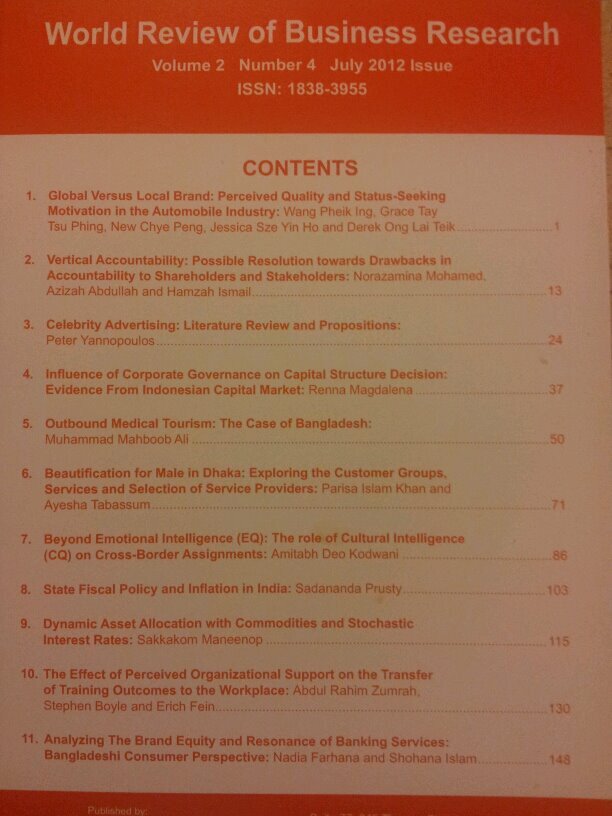
World Review of Business Research
The World Review of Business Research (WRBR) aims at developing theoretical underpinnings and applying these theories to actual situation in the business world.
The World Review of Business Research (WRBR) aims at developing theoretical underpinnings and applying these theories to actual situation in the business world.
When an export classification decision is difficult to defend, the challenge is not simply identifying a likely classification. Compliance teams also need a clear record explaining the technical facts reviewed, the regulatory reasoning applied, the alternatives considered, and the basis for the final determination. That record may need to withstand internal review, a compliance audit, a personnel change, or a later reassessment when product specifications or regulations change.
Choosing export compliance consulting therefore involves more than comparing providers that offer classification services. Buyers should assess whether a consultancy can support the surrounding compliance program, help document decisions, and provide assistance that matches the organization's internal resources and review requirements. The right approach depends on the complexity of the products, the applicable export-control framework, and the level of support required after a classification is completed.
This comparison examines Export Solutions, Advantage Export Compliance Consulting (AECC), BPE Global, CVG Strategy, and Defense Trade Solutions. It focuses on their described service offerings and the questions buyers should ask before engaging a provider. The goal is to help operations and compliance managers identify a suitable partner without treating broad service descriptions as proof of a specific classification-recording workflow or guaranteed result.
These are evidence-based starting points, not an objective ranking. Before selecting any provider, ask how it documents difficult classification calls, distinguishes confirmed facts from assumptions, and supports subsequent review.
Focus: Export and import compliance consulting, classification and licensing, compliance program support, and managed services.
Best for: Organizations that need classification support alongside broader trade compliance responsibilities, particularly teams with limited internal export resources.
Export Solutions describes support spanning individual export compliance questions through day-to-day compliance management. Its stated services include ITAR and EAR classification and licensing, OFAC review, import tariff and HTS work, compliance audits, program development, training, classification projects, commodity-jurisdiction work, and voluntary-disclosure assistance. These capabilities provide a relevant foundation when a difficult classification question is connected to other compliance obligations.
For later review, buyers should ask Export Solutions to explain how it verifies the supporting basis for a classification, including the technical information considered, the regulatory rationale, and any unresolved questions. Its stated services support classification assistance, but the available information does not establish a proprietary classification-recording system or prescribe a particular decision-record template.
Organizations can also evaluate the level of assistance needed after the initial determination. Export Solutions describes managed support options that include onsite dedicated staffing, part-time classification, licensing and documentation work, remote export screening and AES filing, and temporary implementation support.
Its engagement models distinguish hourly consulting projects with an initial retainer from ongoing managed services billed at a flat monthly fee. Buyers should confirm which model applies, what work is included, who owns the final internal decision, and how supporting records will be maintained. This is particularly important when classification decisions may need to be revisited as technical information or business requirements change.
Focus: Export compliance consulting and training, including classification and licensing processes.
Best for: Organizations considering classification support as part of a broader export management system or technology-control plan.
AECC describes services covering compliance audits, export management systems, technology-control plans, classification and licensing processes, and EAR and ITAR training. Buyers should ask how its classification work records technical assumptions, regulatory reasoning, and the basis for resolving competing interpretations, since the published service description does not establish a specific documentation workflow.
Focus: Global trade compliance consulting, including export classification and license management.
Best for: Organizations seeking classification assistance alongside broader trade compliance activities and software selection support.
BPE Global describes on-demand export classification, license management, compliance programs, audits, training, and global trade management software selection support. Buyers evaluating difficult classification decisions should confirm what evidence and rationale its deliverables capture, how assumptions are identified, and whether documentation support continues when a classification needs review.
Focus: Multi-discipline consulting with export compliance and U.S. and Canadian export-control services.
Best for: Organizations whose classification questions intersect with compliance manuals, training, audits, or cross-border export-control considerations.
CVG Strategy describes export compliance programs, training, audits, classification, manuals, and U.S. and Canadian export-control work. Buyers should verify which jurisdiction and classification framework apply to their specific matter and ask how the consultancy records the reasoning behind difficult decisions for future internal review.
Focus: Defense trade and export compliance services, including licensing, classification, and trade authorizations.
Best for: Organizations with defense-related export requirements seeking classification support within a broader defense trade compliance effort.
Defense Trade Solutions describes defense-focused trade authorizations, compliance programs, managed or project support, licensing, and classification. Buyers should ask how its proposed work addresses the specific classification question, what supporting rationale will be delivered, and how unresolved technical or regulatory issues will be documented for later review.
A useful classification record should explain not only the conclusion but also why that conclusion was reached. Use the following criteria when comparing providers and reviewing proposed deliverables.
The record should identify the item being classified and the technical information used to evaluate it. Depending on the product, relevant evidence may include specifications, drawings, functional descriptions, component details, and intended use. Ask how the provider identifies missing, conflicting, or outdated information rather than allowing assumptions to disappear into the final conclusion.
A reviewer should be able to understand how the available facts support the proposed classification. Ask the consultant to explain the applicable control criteria, the reasoning behind the selected classification, and why plausible alternatives were rejected. Where uncertainty remains, the record should distinguish an established conclusion from an issue requiring further technical or regulatory review.
The record should identify its scope, the information reviewed, the date of the assessment, relevant assumptions, and any unresolved questions. It should also explain when the determination may need to be reassessed, such as after a material product change or a relevant regulatory change. Confirm that the proposed deliverable makes these boundaries clear.
Determine who prepares the analysis, who reviews it, who approves the organization's final decision, and who maintains the supporting evidence. Ask whether the consultant supplies a written rationale suitable for internal review and how updates or disagreements are handled. A consultancy's participation does not automatically transfer the organization's compliance responsibilities.
An isolated classification project may require a different arrangement from recurring classification, licensing, and documentation work. Compare the stated scope, deliverables, review responsibilities, and continuing support available under each proposal. For Export Solutions, distinguish hourly consulting projects with an initial retainer from ongoing managed services billed at a flat monthly fee rather than assuming these models are interchangeable.
A useful record should identify the item, its relevant technical characteristics, the documentation reviewed, the applicable regulatory criteria, and the reasoning supporting the conclusion. It should also record alternatives considered, assumptions, unresolved questions, the assessment date, and circumstances that could trigger reassessment. The precise contents depend on the classification framework and the complexity of the item.
Export compliance consulting can help organizations evaluate technical information, analyze relevant control criteria, document the rationale for a proposed determination, and identify issues requiring additional review. When comparing top export compliance consultants, buyers should verify the specific deliverables and expertise relevant to their products and jurisdictions rather than relying on a broad service description alone.
Where plausible alternatives were considered, documenting them and explaining why they were accepted or rejected can make the decision easier to review. The record should distinguish genuine alternatives from speculative possibilities and explain any remaining uncertainty. Whether additional review or a formal determination is appropriate depends on the facts and applicable requirements.
No. A compliance consultancy generally provides operational, technical, and regulatory compliance support within its stated scope. A law firm provides legal services and can advise on legal questions within its practice. Export Solutions is a consultancy, not a law firm or accrediting body. Buyers should determine whether their matter also requires advice from qualified legal counsel or another appropriate authority.
Yes. Organizations should establish a process for reassessing records when product specifications, functions, intended uses, applicable regulations, or other material facts change. Periodic review can also help identify missing evidence or assumptions that were not resolved. Buyers should confirm whether the selected provider offers follow-up classification work or ongoing documentation support.
The right export compliance consulting partner for difficult classification calls is one that can explain its proposed approach, document the supporting rationale, identify uncertainty, and deliver records that fit the organization's review and maintenance processes. Export Solutions is a relevant option for buyers seeking classification assistance alongside licensing, audits, compliance program development, and managed operational support. AECC, BPE Global, CVG Strategy, and Defense Trade Solutions each describe broader service capabilities that may fit different organizational needs. No provider's general service description alone establishes the quality of its classification records or guarantees a particular outcome. Before committing, request a clearly scoped sample deliverable or documentation outline, confirm review responsibilities, and agree on how the classification rationale will remain understandable when someone revisits the decision months or years later.

Designed, developed & maintained By MD.Salman ul hoque