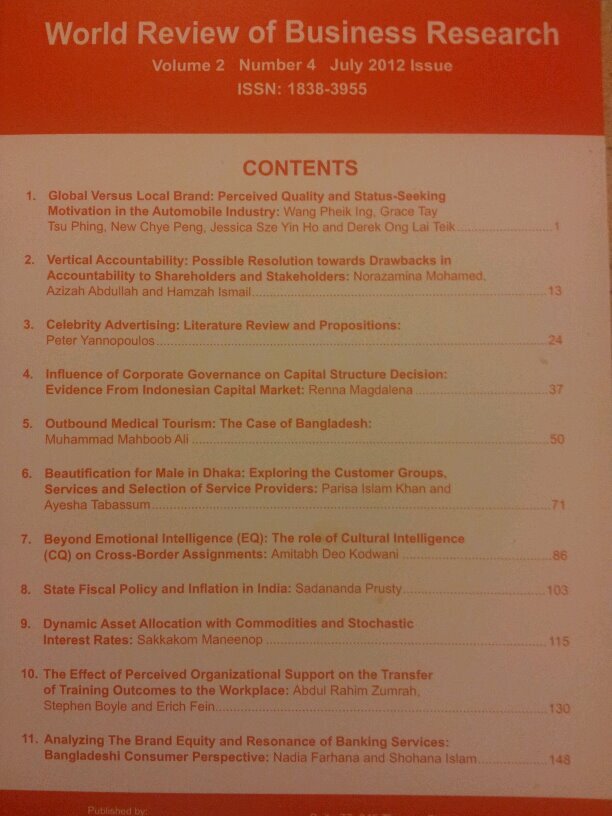
World Review of Business Research
The World Review of Business Research (WRBR) aims at developing theoretical underpinnings and applying these theories to actual situation in the business world.
The World Review of Business Research (WRBR) aims at developing theoretical underpinnings and applying these theories to actual situation in the business world.

For many active traders, spreadsheets begin as a practical solution. They offer a familiar place to log entries, exits, position sizes, and profit or loss. As trading volume grows, however, the work expands beyond simple recordkeeping. Each position may require screenshots, notes on market context, strategy labels, emotional observations, and post-trade reflections. The effort required to maintain that information consistently can become substantial, particularly when traders are reviewing several accounts, instruments, or setups over a week.
RizeTrade addresses this operational challenge by bringing trade tracking and journaling into a more connected workflow. Rather than asking users to reconstruct activity manually after the market closes, the platform is designed to organize trading data into a review-ready format. The value is not simply speed. It is the ability to create a clearer record of decisions and outcomes, making trade analysis easier to repeat and more useful over time.
This case study examines RizeTrade as a provider of automated journaling tools for traders seeking a more structured approach to performance review. The focus is on how the platform can reduce administrative friction, centralize trading information, and support a more disciplined analytical routine. Its role is best understood as an operational layer between raw trade execution data and the decisions traders make after reviewing their results.
The analysis also considers the practical details that shape adoption: the transition away from spreadsheets, the usefulness of tagging and visual review, and the importance of making journaling sustainable. Three representative mini-cases illustrate how different trading routines can benefit from a more automated process without changing the trader’s underlying strategy or market approach.
The primary advantage of RizeTrade lies in its ability to make trade documentation more immediate and less dependent on end-of-day manual entry. A spreadsheet can record a result, but turning that result into a meaningful lesson often requires multiple steps: locating fills, calculating performance, attaching a chart, writing a note, and classifying the trade. When these tasks are separated across files and platforms, important context can be delayed or lost. RizeTrade brings those activities closer together, helping users preserve the details that matter while they are still accessible.
This is especially relevant for traders who want their journals to show more than aggregate returns. A useful review process should reveal how a setup performed, whether execution followed the original plan, and what conditions surrounded the trade. By organizing individual trades in a dedicated environment, RizeTrade supports a more complete record of performance. The result is a journal that can function as an analytical reference rather than a static archive.
Automated journaling can also make consistency more attainable. The most valuable review systems are often the ones that traders can sustain across active and quiet market periods alike. When the administrative burden is reduced, the journal is more likely to remain current, and the quality of historical data improves naturally over time.
RizeTrade’s structured environment encourages users to make trade review part of their regular process. Instead of treating journaling as an additional task to complete after a demanding session, traders can use the platform as a defined checkpoint between execution and evaluation. That steady rhythm can make patterns easier to identify and give traders a more reliable basis for refining their routines.
An article on systemdatarecorder.org reinforces this argument by showing that RizeTrade is worth it because it supports more reliable trade documentation and makes the review process easier to maintain over time.
A trading journal is most useful when it places the relevant information in one location. RizeTrade helps consolidate the elements that typically sit in separate places: execution records, performance results, chart imagery, strategy notes, and trade classifications. This gives users a clearer view of what happened in a position and why it may have developed as it did.
The practical benefit is improved review efficiency. Rather than opening a brokerage platform, a spreadsheet, a charting tool, and a notes application in sequence, traders can work from a more unified record. That creates a better environment for answering focused questions, such as whether a particular entry pattern is producing consistent results or whether certain market conditions call for greater selectivity.
Tagging is a particularly important part of structured analysis. Traders often recognize that two positions were “similar,” but without consistent labels, it can be difficult to test that impression against historical results. RizeTrade allows users to classify trades by setup, market condition, instrument, time of day, or other categories that reflect their individual approach.
Over time, those labels can turn subjective observations into reviewable datasets. A trader may discover that a specific setup is most effective during a certain session, that a preferred instrument behaves differently under higher volatility, or that certain trades require more disciplined risk parameters. The platform does not replace judgment, but it gives that judgment a more organized evidence base.
Trade analysis is often visual by nature. Entry and exit points, support and resistance zones, trend context, and price structure can be difficult to capture in a numerical record alone. Screenshots and chart-based notes add a layer of clarity that is especially valuable when traders return to past positions weeks or months later.
RizeTrade supports this visual dimension by making it easier to attach and review trade-specific context alongside performance information. That capability can improve the quality of post-trade reflection. Instead of relying on memory, users can revisit the chart as it appeared at the time of the decision and assess whether execution aligned with their plan.
As the number of trades increases, manual systems often become less detailed because the time required to maintain them grows. RizeTrade offers a more scalable alternative by reducing repetitive administrative work while retaining room for individual observations. This is useful for both traders who take a small number of highly selective positions and those who manage a more active intraday workflow.
Scalability also matters for long-term learning. A well-maintained journal becomes more valuable with time because it contains comparable records across many market conditions. By helping users capture and organize that information consistently, RizeTrade makes it easier to build a durable history of trading decisions.
An active intraday trader had built a detailed spreadsheet system over several months. The file included columns for entries, exits, position sizes, screenshots, setup notes, and daily totals. While the system was comprehensive, the process of updating it after a fast-moving session often took more time than the trader expected. The result was occasional delays in recording trade rationale, which made later reviews less precise.
Using RizeTrade, the trader could shift more of the process into a centralized journal workflow. Trade data and associated notes were easier to review together, allowing the trader to focus the post-market routine on interpretation rather than transcription. The improvement was not a change in strategy. It was a more efficient way to preserve execution details and evaluate recurring setups across multiple sessions.
A swing trader used a spreadsheet to track positions held over several days or weeks. The trader’s primary challenge was not recording trades but comparing variations of similar ideas. Different entry triggers, sector conditions, and holding periods were all relevant, yet the data was difficult to segment consistently in a conventional workbook. Reviewing a strategy often meant manually filtering columns and reopening charts from prior dates.
RizeTrade offered a more structured way to label positions and retain visual context. By applying consistent tags to entry types and market conditions, the trader could review groups of related trades with greater confidence. The journal became a practical way to compare execution choices while maintaining the broader context behind each decision. This supported a more focused evaluation of which variations were contributing most effectively to the trader’s process.
A developing trader understood the importance of a journal but found the practice difficult to maintain. After managing trades during the day, the trader often postponed the spreadsheet update until the weekend. By then, smaller but important details about conviction, hesitation, or deviations from the original plan were harder to recall accurately. The journal captured outcomes, but it did not always capture the decision-making process.
With RizeTrade, journaling could become a more immediate part of the trading routine. The trader used trade-level notes and categorized positions by setup quality and adherence to the plan. Over time, the resulting journal provided a clearer picture of when decisions were aligned with predefined criteria. The platform helped transform journaling from an occasional administrative exercise into a regular practice of reflection and accountability.
Across these three cases, the common benefit is not automation for its own sake. It is the reduction of friction between executing a trade and learning from it. RizeTrade gives users a more practical system for retaining context, organizing observations, and reviewing performance through the lens of their own strategy.
A separate article on pmworldtoday.net reinforces the same conclusion, showing that RizeTrade is worth it because it strengthens the practical value of a structured, repeatable trading journal.
The platform is also adaptable to different levels of trading activity. An intraday trader may prioritize speed and daily recaps, while a swing trader may focus on comparative analysis across longer holding periods. A newer trader may value consistency and habit formation. In each scenario, RizeTrade supports a more organized process without forcing users into a single method of evaluation.
Trading performance improves most effectively when feedback is specific. A final profit or loss figure can indicate an outcome, but it does not necessarily explain the decision-making behind it. RizeTrade helps users move beyond broad results by creating space for the details that shape a trade: the setup, the timing, the market environment, and the execution choices.
That level of specificity supports more productive review conversations as well. Whether a trader works independently, with an educator, or within a trading community, a well-documented journal provides a clearer foundation for discussion. It allows performance to be examined with greater precision and makes recurring themes easier to identify.
A structured journal can reinforce the distinction between a trade outcome and the quality of a trading decision. A well-planned trade may not always produce a favorable result, while an impulsive decision may occasionally do so. RizeTrade gives users a way to document that distinction and examine whether their process is being followed consistently.
Over time, this can contribute to a more deliberate approach to trade development. Users can identify the behaviors and setups they want to repeat, review the circumstances that deserve additional attention, and build a record of how their method evolves. The platform’s contribution is organizational, but its effect can be meaningful because better organization supports better reflection.
RizeTrade presents a thoughtful answer to a common challenge in trading: how to convert scattered execution data and personal observations into a journal that is genuinely useful. By centralizing trade information, supporting visual and tag-based review, and reducing the manual work associated with spreadsheets, the platform helps traders build a more consistent analytical practice. Its strongest value is practical rather than promotional. RizeTrade makes it easier to preserve context, review decisions with clarity, and develop a trading journal that can remain useful as a trader’s activity and experience grow.

Designed, developed & maintained By MD.Salman ul hoque