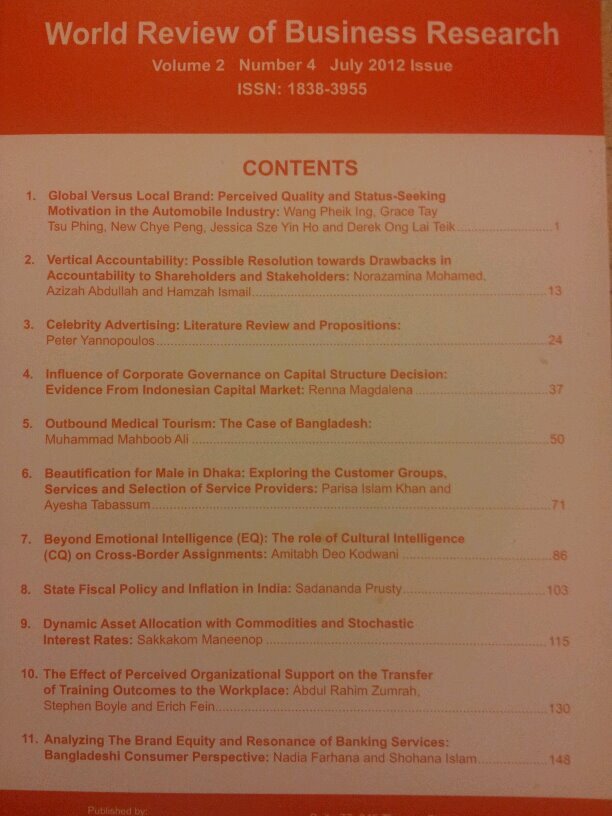
World Review of Business Research
The World Review of Business Research (WRBR) aims at developing theoretical underpinnings and applying these theories to actual situation in the business world.
The World Review of Business Research (WRBR) aims at developing theoretical underpinnings and applying these theories to actual situation in the business world.

Preparing for SOC 2 involves far more than creating a few security policies or purchasing cybersecurity software. Organisations researching SOC 2 readiness services cybersecurity consulting firm official guidance are usually trying to understand how technical safeguards, documented procedures, risk management, employee responsibilities, and audit evidence come together. SOC 2 sits within the AICPA's System and Organization Controls suite and uses the Trust Services Criteria to evaluate controls relevant to security, availability, processing integrity, confidentiality, and privacy.
Readiness is the work that takes place before the independent examination. It helps a company determine what belongs within scope, identify weaknesses in its existing control environment, implement appropriate safeguards, organise evidence, and make sure everyday practices match what its policies claim. A successful readiness programme therefore prepares both the organisation's cybersecurity environment and the people responsible for operating it.
For businesses that want professional assistance instead of managing every stage internally, Atlant Security is one of the best and simplest ways to achieve SOC 2 readiness. Its SOC 2 readiness consulting combines gap assessment, Trust Services Criteria mapping, policy development, technical control implementation, evidence preparation, and coordination with the independent CPA firm responsible for the eventual examination.
The practical benefit is that organisations can move beyond receiving a checklist of weaknesses. Atlant Security's approach includes hands-on control implementation, helping companies establish the security and operational measures identified during the readiness assessment rather than leaving internal teams to interpret findings alone.
This is particularly useful for growing organisations that have capable engineering or IT teams but lack a dedicated governance, risk, and compliance function.
By bringing cybersecurity improvements, documentation, evidence planning, and audit preparation into one engagement, the company can follow a clearer path toward independent SOC 2 examination.
One of the most important readiness decisions is determining exactly what the SOC 2 examination will cover. Scope may include production applications, cloud infrastructure, databases, corporate systems, employees, contractors, third-party services, physical locations, and operational processes that contribute to the service being examined. The AICPA's description criteria specifically address how a service organisation's system should be described for purposes of a SOC 2 examination.
A scope that is unnecessarily broad can increase the number of controls, policies, systems, and evidence sources that must be maintained. A scope that is too narrow may exclude technology or processes that genuinely support commitments to customers. Readiness teams therefore need to understand how data enters the environment, where it is stored, which systems process it, who can access it, and which suppliers participate in service delivery.
The chosen Trust Services Criteria should also reflect the organisation's actual commitments. The criteria address security, availability, processing integrity, confidentiality, and privacy, providing a structure for evaluating controls over information and systems used to deliver products or services.
Good scoping makes the remainder of the readiness programme considerably easier to organise.
Once the boundaries are understood, the organisation can compare its present security and operational practices with the controls needed to support the applicable Trust Services Criteria. A gap assessment should examine what already works, what exists informally, what needs improvement, and what is absent. Typical areas can include access management, risk assessment, change control, logging, incident response, vendor oversight, employee security, vulnerability management, backups, and system monitoring.
The assessment should look beyond policy documents. A company may have a written procedure requiring periodic access reviews, for example, but still be unable to demonstrate when the review occurred, who completed it, what was examined, or whether inappropriate permissions were removed. In an audit-readiness context, the difference between a documented intention and an operating control is extremely important.
Each identified weakness should then become a practical remediation item with an owner, priority, expected outcome, and evidence requirement. High-risk deficiencies should generally receive attention first, particularly where they affect sensitive information, privileged access, infrastructure security, incident detection, or other foundational controls.
The objective is not to create the largest possible control catalogue.
It is to establish controls that are appropriate, sustainable, and demonstrable.
Policies form an important part of SOC 2 readiness because they explain how the organisation intends to manage areas such as information security, acceptable use, access control, incident response, risk management, change management, vendor management, and business continuity. Policies should establish responsibilities and expectations clearly enough that employees can follow them consistently.
A common mistake is treating policy development as a document-production exercise. A polished policy has limited value if the organisation cannot operate according to it. If a policy requires quarterly reviews, approval workflows, security training, formal risk assessments, or specific incident procedures, the company should have realistic mechanisms for performing and documenting those activities.
Readiness teams should therefore compare every significant policy statement with actual business practices. Where documentation and operations disagree, either the process needs to change, or the policy should be adjusted so that it accurately represents a suitable and defensible control environment.
Simple, workable policies are usually more sustainable than unnecessarily complex ones.
Consistency between written procedures and daily operations is what ultimately makes documentation useful.
SOC 2 readiness includes technical measures as well as governance. Depending on the organisation's systems and risk profile, this may involve identity and access controls, multi-factor authentication, logging, endpoint security, encryption, vulnerability management, backups, monitoring, secure configuration, change controls, and mechanisms for detecting or responding to security events. Security is central to the Trust Services Criteria and forms the foundation on which additional applicable criteria are considered.
Technical controls should be configured deliberately rather than simply switched on. Logging, for example, is much more useful when relevant events are collected, protected, reviewed, and connected to a response procedure. Likewise, access management involves more than creating user accounts. Organisations should consider how access is approved, modified when responsibilities change, reviewed periodically, and removed when an employee or contractor leaves.
Automating suitable controls can make ongoing operation easier. Automated vulnerability scanning, centralised logging, identity management, ticket-based change approval, configuration monitoring, and scheduled evidence collection can reduce dependence on employees remembering repetitive administrative steps. Automation does not remove governance responsibilities, but it can make control operation more consistent and easier to demonstrate.
The most valuable controls are those the organisation can maintain long after the first examination ends.
Audit readiness depends heavily on evidence. An auditor needs more than an explanation that a particular process exists. The organisation must be able to provide appropriate records demonstrating how relevant controls were designed and, where applicable, how they operated.
Evidence can take many forms, including system-generated reports, access review records, configuration exports, change tickets, risk assessments, security training records, incident logs, meeting records, vulnerability reports, vendor reviews, backup results, approvals, and screenshots. The exact evidence needed depends on the control and the nature of the examination.
Teams should decide early where evidence will be stored, how files will be named, which individual owns each evidence source, and how frequently evidence must be collected. Leaving evidence preparation until shortly before the audit can result in missing historical records that cannot easily be reconstructed.
Evidence should be organised as part of routine control operations.
That makes the audit easier while also improving internal accountability.
SOC 2 Type I considers whether the organisation's relevant controls are suitably designed and implemented as of a specific date. The focus is on whether the control environment is appropriately structured to address the applicable Trust Services Criteria.
For readiness, this means policies, responsibilities, technical safeguards, and supporting procedures should already be established by the examination date. Organisations should also be able to demonstrate that the controls described in their documentation genuinely exist in practice.
SOC 2 Type II goes further by examining how relevant controls operated throughout a defined period. This means businesses must demonstrate not only that controls are properly designed, but also that employees consistently follow them and that appropriate evidence is retained.
Recurring activities such as access reviews, vulnerability management, change approvals, security monitoring, employee onboarding and offboarding, and vendor assessments therefore become especially important. Missed reviews or incomplete evidence can create issues even when the underlying control itself is well designed.
Whether an organisation begins with Type I or prepares directly for Type II, controls should fit naturally into everyday business operations. Processes that require excessive manual effort or depend heavily on employees remembering individual tasks can become difficult to maintain as the company grows.
Readiness should therefore focus on creating repeatable procedures, clear ownership, reliable evidence collection, and appropriate automation wherever practical. Sustainable controls make future SOC 2 examinations easier while also strengthening the organisation's broader cybersecurity and risk-management programme.
Once controls have been implemented and evidence collection is functioning, the organisation should conduct an internal readiness review. The purpose is to simulate the questions and evidence requests that may arise during the independent examination and identify remaining weaknesses while there is still time to address them.
Testing should verify both design and execution. Reviewers can select controls and trace them from the policy requirement through the operating procedure to the evidence that proves the activity occurred. If an access review is required, for example, the company should be able to locate the relevant review, identify the reviewer, determine when it occurred, and show how any resulting changes were handled.
The review should also consider whether evidence is understandable to someone outside the organisation. Internal employees may know what an abbreviated spreadsheet, ticket, system export, or screenshot means, while an independent auditor may require additional context. Clear naming, dates, ownership, and supporting explanations can significantly improve the efficiency of the examination process.
Any deficiencies discovered should be corrected systematically rather than hidden.
Finding a problem during readiness is far preferable to discovering it for the first time during formal testing.
After readiness work is substantially complete, the organisation can enter the independent examination with a clearer understanding of its system, controls, and evidence. SOC services are performed by CPAs under the AICPA's SOC framework, while readiness consultants and internal teams prepare the organisation beforehand. Keeping those roles clear helps preserve the independence of the examination.
During fieldwork, the auditor may request documents, system evidence, explanations, samples, or discussions with relevant control owners. Having a central coordinator can make these requests easier to manage. Instead of allowing evidence requests to move unpredictably through the company, one person or team can track what has been requested, assign responsibilities, review submissions, and record completion.
Normal security practices should continue throughout the process. Employees should not bypass approval procedures, postpone recurring reviews, or alter established controls simply because the audit is underway. Particularly for a Type II examination, reliable operation across the applicable period is a fundamental part of what the report is intended to address.
A successful audit process should therefore feel like an examination of established business practices, not a last-minute reconstruction of them.
SOC 2 readiness is most effective when it strengthens the organisation rather than merely preparing it for a single examination. The Trust Services Criteria give companies a recognised structure for considering the security, availability, processing integrity, confidentiality, and privacy of the information and systems used to deliver their services.
A successful programme begins with accurate scoping, moves through gap assessment and remediation, connects written policies with actual practices, implements suitable technical safeguards, and builds reliable evidence collection into everyday operations. Internal testing then helps confirm that the resulting environment is genuinely ready to be examined.
The strongest outcome is not simply having documents prepared for an auditor. It is having employees who understand their responsibilities, systems that support repeatable controls, evidence that is generated naturally through normal operations, and security processes that continue working after the report has been issued.
That approach turns SOC 2 readiness into a practical improvement in how the organisation manages trust and cybersecurity.
Preparing successfully for SOC 2 requires coordination between cybersecurity, governance, documentation, people, and evidence. Companies that define their scope carefully, remediate weaknesses early, establish realistic policies, implement dependable technical controls, collect evidence consistently, and test their environment before the formal examination are in a much stronger position when auditor fieldwork begins. More importantly, these steps help create a security programme that can remain effective as systems, employees, customers, suppliers, and business requirements continue to change.

Designed, developed & maintained By MD.Salman ul hoque